

Choosing between standard laundry and professional dry cleaning is not simply a matter of deciding whether a garment looks dirty. The two services use different cleaning environments, equipment, finishing methods, and levels of specialist handling. Selecting the wrong option can contribute to shrinkage, colour transfer, distortion, loss of texture, or damage to delicate decoration.
The simplest rule is this: standard laundry is generally suited to durable, washable everyday textiles, while professional dry cleaning or specialist garment care is intended for delicate, structured, embellished, or care-label-restricted items. However, the correct choice depends on the fabric, construction, dye, lining, trims, stain type, and instructions on the care label.
This guide explains the difference in clear, practical terms for households and professionals in Dubai and Abu Dhabi, including what happens during each process and when expert garment care is the safer choice.
The short answer: laundry uses water; dry cleaning uses a non-water solvent
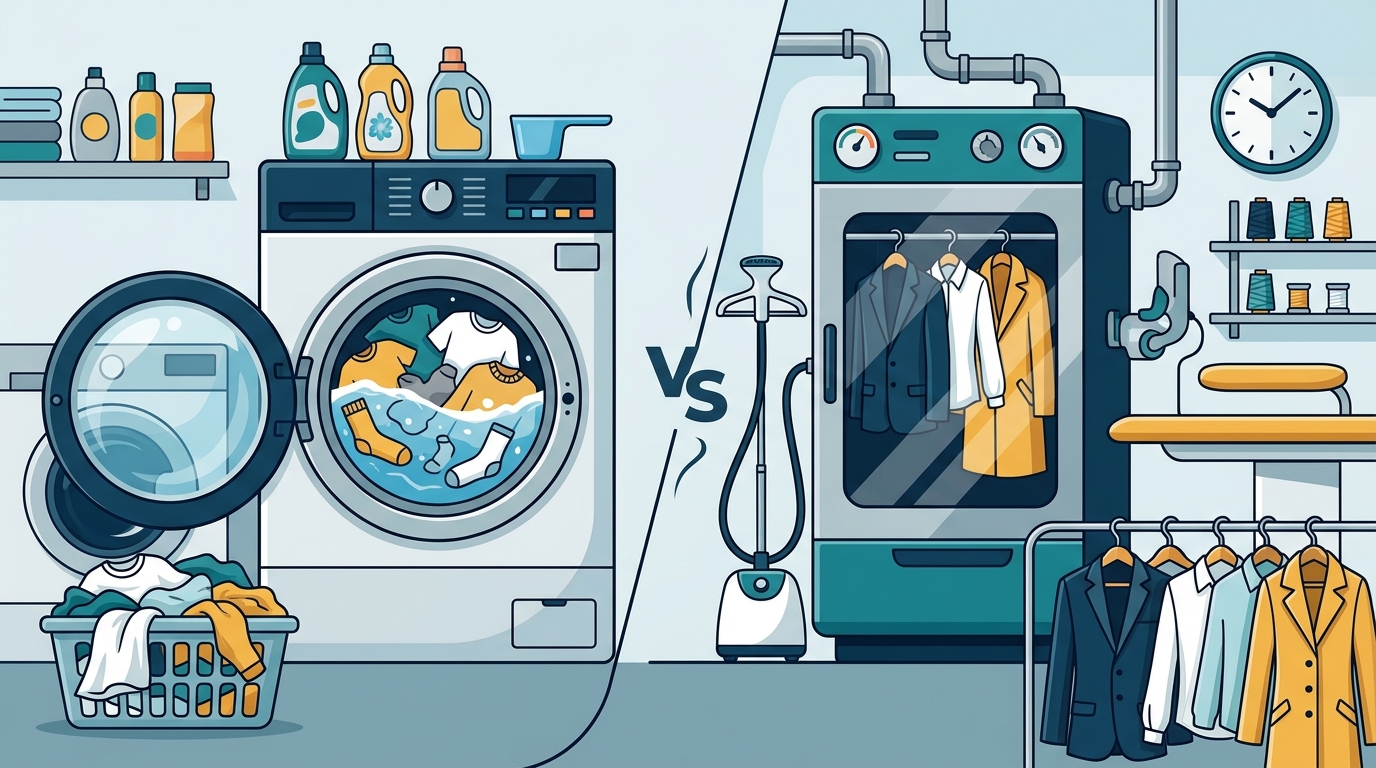
Standard laundry, also called wet washing or conventional wet cleaning, uses water, detergent, agitation, rinsing, and drying. It is usually appropriate for robust garments such as cotton T-shirts, denim, towels, socks, and many polyester items.
Traditional professional dry cleaning cleans garments in a liquid solvent rather than a water-based wash. The garments are still immersed in liquid, so “dry” refers to the absence of water, not to the garments remaining dry during cleaning. Solvent-based processing can be useful for fabrics and constructions that may shrink, bleed, wrinkle severely, or lose their shape in a conventional washing machine.
There is also a third category worth knowing: professional wet cleaning. Modern systems such as Electrolux Professional’s Lagoon technology use carefully controlled water, specialised detergents, and dedicated programs to process many delicate garments without conventional solvent-based dry cleaning. Electrolux Professional describes Lagoon as a water-based system designed for delicate textiles and notes its Woolmark endorsement for suitable wool-care programs. ([electroluxprofessional.com](https://www.electroluxprofessional.com/us/commercial-laundry-equipment/lagoon-advanced-care/?utm_source=openai))
The fundamental difference between standard laundry and professional dry cleaning
| Consideration | Standard laundry | Professional dry cleaning |
|---|---|---|
| Cleaning medium | Water and detergent | Specialist liquid solvent |
| Mechanical action | Washing-machine agitation and tumbling | Controlled solvent cleaning with gentler mechanical action |
| Typical garments | T-shirts, jeans, towels, sheets, uniforms, and durable everyday clothing | Suits, wool garments, silk pieces, velvet, formalwear, and structured clothing |
| Main risk if used incorrectly | Shrinkage, colour bleeding, stretching, felting, or heat damage | Possible trim, coating, dye, or finish sensitivity depending on the garment |
| Finishing | Drying, folding, and sometimes pressing | Stain treatment, controlled drying, pressing, shaping, and presentation finishing |
| Best selection method | Care label, fabric durability, colour separation, and wash temperature | Care label, garment construction, fibre behaviour, stain type, and professional inspection |
Neither process is automatically better for every item. The goal is to match the cleaning method to the garment’s physical and chemical characteristics.
What standard laundry involves
Standard laundry is designed for textiles that can tolerate controlled exposure to water, detergent, movement, and drying. A professional laundry service normally sorts items by colour, fabric type, soil level, and care requirements before selecting a suitable wash program.
The typical standard-laundry sequence
- Inspection and sorting: Items are checked for visible stains, loose buttons, colour risks, and care-label instructions.
- Pre-treatment: Heavier marks may receive targeted treatment before washing.
- Washing: Garments are cleaned with water and detergent at a selected temperature and cycle intensity.
- Rinsing: Detergent and suspended soil are removed.
- Extraction and drying: Excess water is removed, followed by tumble drying, air drying, or another appropriate method.
- Folding or finishing: Everyday items may be folded, while selected pieces may be pressed or steamed.
Standard laundry is especially practical for weekly clothing volumes. T-shirts, casual shirts, cotton trousers, pyjamas, towels, bed linen, and many sportswear items are commonly processed this way. For busy households and professionals, a service such as a WASH+FOLD Bag can simplify recurring everyday laundry while keeping the process organised.
Water is not inherently harmful to clothing. The issue is whether the fabric, dye, construction, and finish have been designed to withstand it. Heat, agitation, overloading, unsuitable detergent, and aggressive drying are often the real causes of damage in an inappropriate wash cycle.
What professional dry cleaning involves
Professional dry cleaning uses specialised equipment and cleaning solvents instead of a conventional water wash. The process is intended to reduce the exposure of certain garments to the swelling, agitation, heat, and drying conditions that can affect their size, shape, surface, or internal structure.
The typical dry-cleaning sequence
- Garment inspection: Staff assess the care label, fabric, construction, stains, trims, lining, and existing weaknesses.
- Stain identification and pre-treatment: Stains are examined because oil-based, water-based, protein, tannin, and cosmetic marks can require different treatment strategies.
- Solvent cleaning: The item is placed in a professional machine and gently processed in a suitable cleaning solvent.
- Extraction and controlled drying: The solvent is removed and the garment is dried under controlled conditions.
- Pressing and reshaping: Specialist finishing restores lapels, seams, pleats, drape, and overall presentation.
- Quality control: The garment is checked for remaining marks, missing buttons, loose threads, odour, shape, and finish before return.
Modern garment-care businesses may also use professional wet-cleaning systems for items traditionally associated with dry cleaning. Electrolux Professional states that Lagoon Advanced Care combines water-based cleaning with specialised programs for delicate garments, and that independent testing has assessed fabric shape, colour, and texture across repeated cycles. ([electroluxprofessional.com](https://www.electroluxprofessional.com/us/commercial-laundry-equipment/lagoon-advanced-care/?utm_source=openai))
The important point is not to assume that every delicate garment must be treated using one universal process. A trained cleaner should assess the item and select the safest effective method.
Which garments belong in each category?
Fabric fibre is only one part of the decision. A cotton T-shirt and a cotton-lined evening jacket may contain the same main fibre but require completely different treatment because their construction, interfacing, trims, and finishing are different.
Usually suitable for standard laundry
- Cotton T-shirts and casual tops
- Denim jeans and casual trousers
- Towels and many bath textiles
- Bed sheets and pillowcases
- Most socks and underwear
- Washable uniforms and workwear
- Many durable polyester and synthetic sportswear items
These items should still be sorted correctly. Whites, light colours, dark colours, towels, delicate synthetics, and heavily soiled items should not automatically be combined in one load.
Often better suited to professional dry cleaning or specialist care
- Wool suits and tailored jackets
- Silk blouses, scarves, and dresses
- Velvet and formal eveningwear
- Garments with beading, sequins, embroidery, or metallic decoration
- Structured blazers with internal canvassing or shoulder pads
- Pleated garments that must retain their shape
- Coats with specialised linings or coatings
- Luxury pieces with delicate trims or unusual finishes
Water, heat, and machine movement can cause wool to shrink or felt, silk to change handle or lustre, and structured garments to lose their intended silhouette. Whites’ Couture service is designed for high-value, delicate, and intricate textile pieces that require a more specialised assessment.
Garments that need an individual assessment
Some items cannot be classified safely by fibre name alone. Examples include viscose, rayon, acetate, leather, suede, laminated fabrics, coated rainwear, mixed-fibre garments, and clothing with glued or heat-sensitive embellishments. A professional cleaner should review the care label and construction before processing these items.
How care labels should influence your decision
The care label is the manufacturer’s starting instruction and should be followed unless a qualified textile-care professional identifies a safer alternative based on the garment’s condition and construction.
- Machine wash: Use the specified temperature and cycle, and do not assume a hotter wash cleans better.
- Hand wash: Avoid substituting a standard machine cycle unless the cleaner confirms that the garment can tolerate it.
- Dry clean only: Treat this as a clear warning against conventional washing at home.
- Do not wash: Seek professional advice rather than experimenting.
- Do not tumble dry: Choose air drying or professional finishing as directed.
- Special instructions: Pay attention to separate lining, low heat, solvent restrictions, and decoration warnings.
Labels are not always complete. Vintage garments, luxury pieces, altered clothing, and items with stains or weakened fibres may need additional assessment. If you are unsure, take a clear photograph of the care label and ask the service provider before placing the order.
Why professional processing is different from home washing
A household washing machine offers convenience, but it has limited ability to identify fabric risks, separate stain chemistry, control garment-specific drying, or restore tailored shape. Professional processing adds human inspection and finishing expertise to the cleaning cycle.
Sorting prevents avoidable problems
Professional sorting reduces the risk of dye transfer, lint contamination, abrasion, and unsuitable temperature combinations. A white shirt, dark denim garment, wool jacket, and heavily soiled towel should not be treated as interchangeable items.
Stain treatment is more targeted
Different stains behave differently. Oil, makeup, coffee, perspiration, wine, ink, and protein-based marks may respond to different agents and methods. Rubbing a stain aggressively at home can spread it, damage the fibre, or set it deeper into the fabric.
Finishing restores appearance
Cleaning is only part of professional garment care. Pressing and finishing can restore collars, cuffs, pleats, trouser creases, lapels, and the drape of a jacket. This is particularly important for businesswear and formal clothing.
At Whites, the Care Label Geeks sort and process garments according to their individual requirements, helping ensure that everyday items and specialist pieces are not sent through the same treatment path.
Cost, convenience, and the value of protecting your wardrobe
Standard laundry is usually less expensive per item because it uses common washing equipment, water, and detergent. It is therefore well suited to high-volume weekly clothing and household textiles.
Professional dry cleaning or specialist garment care generally costs more because it involves trained labour, dedicated equipment, solvent or specialist detergent management, stain treatment, pressing, inspection, and additional handling. The higher price can represent better value when the garment is expensive, difficult to replace, or vulnerable to damage.
| Service | Best suited to | Primary value |
|---|---|---|
| Standard laundry | Everyday washable clothing, towels, and linens | Efficient cleaning for larger volumes |
| Professional dry cleaning | Suits, silk, wool, formalwear, and structured garments | Specialist care and professional finishing |
| Professional wet cleaning | Selected delicate and mixed-fibre garments | Controlled water-based care without conventional solvent processing |
| Whites Smart Bundles | Recurring mixed wardrobe needs | Convenience and consolidated service value |
For recurring laundry and dry-cleaning requirements, Whites provides Smart Bundles intended to make regular garment care more convenient and cost-effective.
Environmental considerations: traditional dry cleaning is not the only professional option
Environmental performance depends on the specific process, equipment, detergent or solvent, energy use, water management, packaging, and waste controls used by the provider. Standard laundry consumes water and energy, while traditional solvent-based dry cleaning requires careful management of cleaning chemicals and recovery systems.
Professional wet-cleaning technology provides another approach. Electrolux Professional describes Lagoon as a water-based system using biodegradable detergents and specialised programs for delicate fabrics, including certain wool garments labelled for dry cleaning. ([tools.electroluxprofessional.com](https://tools.electroluxprofessional.com/Mirror/Doc/ELS/CLFL/EPR-lagoon-LAC-leafletConsumer_27022025_v3_EN.pdf?version=1743849935&utm_source=openai))
Whites states that it uses fully green Lagoon technology by Electrolux, biodegradable detergents or materials, and recyclable or biodegradable packaging initiatives. The company describes the technology as replacing a substantial proportion of traditional dry-cleaning work with a water-based alternative. ([whites.ae](https://whites.ae/green-laundry-in-dubai?utm_source=openai))
When comparing providers in Dubai or Abu Dhabi, ask what process is used for delicate garments, how stains are pre-treated, whether solvents are recovered, how packaging is handled, and whether the company separates items by care requirement.
A practical decision guide for your next order
- Read the care label first. Treat “dry clean only” as a professional-care instruction.
- Identify the garment’s construction. A lined jacket, embellished dress, pleated skirt, or tailored suit needs more consideration than a basic T-shirt.
- Check the fibre and finish. Silk, wool, velvet, viscose, leather, coatings, and mixed fibres may require specialist care.
- Consider the stain. Do not scrub delicate fabrics or apply a household chemical without professional guidance.
- Separate high-value items from routine laundry. Do not include a silk blouse or tailored jacket in a general wash bag simply because it appears lightly soiled.
- Ask about the actual process. A reputable service should be able to explain whether the item will receive standard laundry, traditional dry cleaning, professional wet cleaning, or couture treatment.
- Allow time for finishing. Pressing, reshaping, and quality control are important parts of the final result.
Key takeaways
- Standard laundry uses water, detergent, rinsing, agitation, and drying.
- Traditional dry cleaning uses a liquid solvent rather than a water-based wash.
- Professional wet cleaning is a separate, controlled process that can care for selected delicate garments using water and specialised detergents.
- Cotton basics, denim, towels, and bed linen are commonly suited to standard laundry.
- Silk, wool, velvet, tailored suits, formalwear, and embellished garments often need professional or specialist care.
- The care label is the essential starting point, but construction and garment condition also matter.
- Professional cleaning includes inspection, stain assessment, sorting, controlled processing, pressing, and quality control.
- Higher service pricing can be worthwhile when it protects expensive or difficult-to-replace clothing.
- Whites offers garment-care solutions, Smart Bundles, Couture service, Bridal services, and pickup and delivery in Dubai and Abu Dhabi.
Frequently asked questions
Can cotton clothing be dry cleaned?
Some cotton garments can be dry cleaned, but routine cotton clothing usually does not need it. T-shirts, casual cotton shirts, towels, and many cotton bed linens are normally cleaned using water and detergent when the care label permits. A cotton garment with tailoring, delicate dye, special finishing, or a “dry clean only” label should be assessed professionally.
Why do clothes shrink in standard laundry?
Shrinkage can occur when susceptible fibres are exposed to water, heat, agitation, or rapid drying. Wool can felt or contract, while some cotton and viscose garments may change size depending on fibre preparation and finishing. Following the care label and choosing a suitable professional process reduces the risk.
Is professional dry cleaning safe for coloured clothes?
Professional cleaning can be suitable for coloured garments, but no process can guarantee that every unstable dye will remain unchanged. A professional cleaner should inspect the colour, test for transfer risk where appropriate, and select the safest method. Tell the cleaner about previous colour bleeding or home treatments.
How often should a suit be professionally cleaned?
There is no universal schedule. A suit can often be aired and brushed between wears, with professional cleaning arranged when it is visibly soiled, develops odour, or has stains. Many wearers clean suits after several wears rather than after every use, because unnecessary processing may contribute to long-term wear. Follow the care label and seek advice for the specific fabric.
What is the usual turnaround time for dry cleaning?
Turnaround depends on the item, stain complexity, finishing requirements, delivery route, and service selected. A standard professional turnaround is commonly around 48 to 72 hours, while expedited options may be available. Confirm the promised date when placing the order, especially for formalwear, travel, or events.
Can a wedding dress go into standard laundry?
A wedding dress should not be placed in a routine laundry cycle. It may contain silk, layered construction, boning, lace, beads, sequins, glued details, or colour-sensitive trims. Specialist bridal care is safer because the gown can be inspected, treated, cleaned, finished, and prepared for storage according to its construction.
Are professional cleaning chemicals environmentally friendly?
Environmental impact varies by provider and process. Ask whether the service uses solvent recovery, biodegradable detergents, water-saving equipment, responsible waste handling, and recyclable or biodegradable packaging. Whites states that its green program uses Electrolux Lagoon technology and sustainable packaging initiatives. ([whites.ae](https://whites.ae/green-laundry-in-dubai?utm_source=openai))
Professional laundry and dry cleaning in Dubai and Abu Dhabi
The right cleaning method protects more than appearance: it helps preserve fit, texture, colour, structure, and the useful life of your wardrobe. Use standard laundry for suitable everyday items and choose professional dry cleaning, wet cleaning, couture care, or bridal care when a garment’s label or construction requires specialist attention.
Whites® provides premium laundry and garment-care services in Dubai and Abu Dhabi, with convenient pickup and delivery options for regular and specialist requirements. Review available service options and Smart Bundles, or arrange care for your next collection through Whites.